Beyond the “Naughty Step”: Understanding the Silent Trauma Within Our Schools
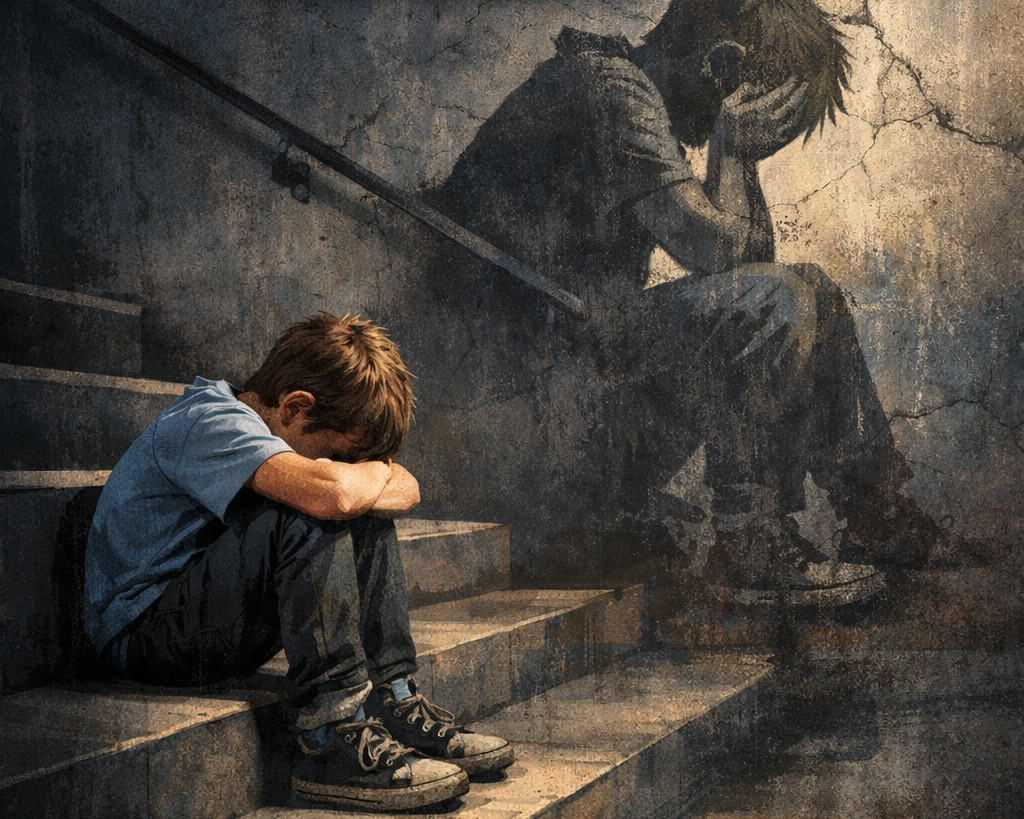
Child sitting alone on school stairs with head down, with a shadow behind him representing hidden trauma, SEMH needs, and emotional distress in UK school children often misunderstood as challenging behaviour.
Across the UK, schools are working incredibly hard to meet the needs of children and young people in an increasingly complex world. At the same time, many educators are navigating rising expectations, limited resources, and growing emotional demands.
Within this context, something important is quietly unfolding.
A Growing Gap Between Need and System
Recent NHS Digital data (2023) suggests that around 1 in 5 children and young people aged 8–25 are experiencing a probable mental health difficulty, including over 20% of those aged 8–16.
This doesn’t reflect a failure of schools. Rather, it highlights a widening gap between what children may need—particularly those affected by adversity or trauma—and what current systems were originally designed to provide.
Many school behaviour systems have been built on understandable intentions: to create safety, consistency, and clear expectations. However, for some children, especially those who have experienced relational trauma, their behaviours may not always be rooted in choice or defiance, but in adaptation, protection, and survival.
When we begin to view behaviour through this lens, a different kind of question emerges:
“What might this child be communicating, rather than controlling?”

The Children We Don’t Always See
In busy school environments, understandably, attention is often drawn to behaviours that disrupt learning.
Yet many children experience distress in quieter ways.
Some may withdraw, appear anxious, struggle to engage, or become physically present but emotionally absent. Guidance from NICE (NG223) reminds us that internalised distress can be harder to recognise, meaning some children may go unnoticed—not because they are coping, but because they are silent.
These children are not “fine.”
They are often working incredibly hard to stay regulated in environments that feel overwhelming.
Expanding how we notice distress—through relationships, observation, pupil voice, and gentle curiosity—can help ensure these children feel seen too.
Moving Beyond Labels and Scores
There has been growing awareness of Adverse Childhood Experiences (ACEs), which has helped open important conversations.
At the same time, current UK guidance does not recommend universal ACE screening in schools. This is not because children’s experiences don’t matter—quite the opposite—but because:
Children’s lives cannot be meaningfully understood through a single score
Asking about trauma requires safe, responsive support pathways
Experiences do not define outcomes—relationships and environments matter deeply
Instead, many schools are moving towards a “know the child well” approach—one that values context, relationships, and understanding over labels.
This relational approach allows children to be seen as whole individuals, not as a set of risk factors.
What Does “Trauma-Informed” Really Mean in Schools?
Being trauma-informed does not mean turning schools into clinical settings.
It means creating environments where children experience:
Safety
Predictability
Connection
Clear, consistent boundaries
These are not “soft” approaches.
They are the foundations that allow learning to happen.
For children who need more specialist support, services such as Mental Health Support Teams (MHSTs)—now reaching over half of pupils in England—play an essential role in bridging education and clinical care.
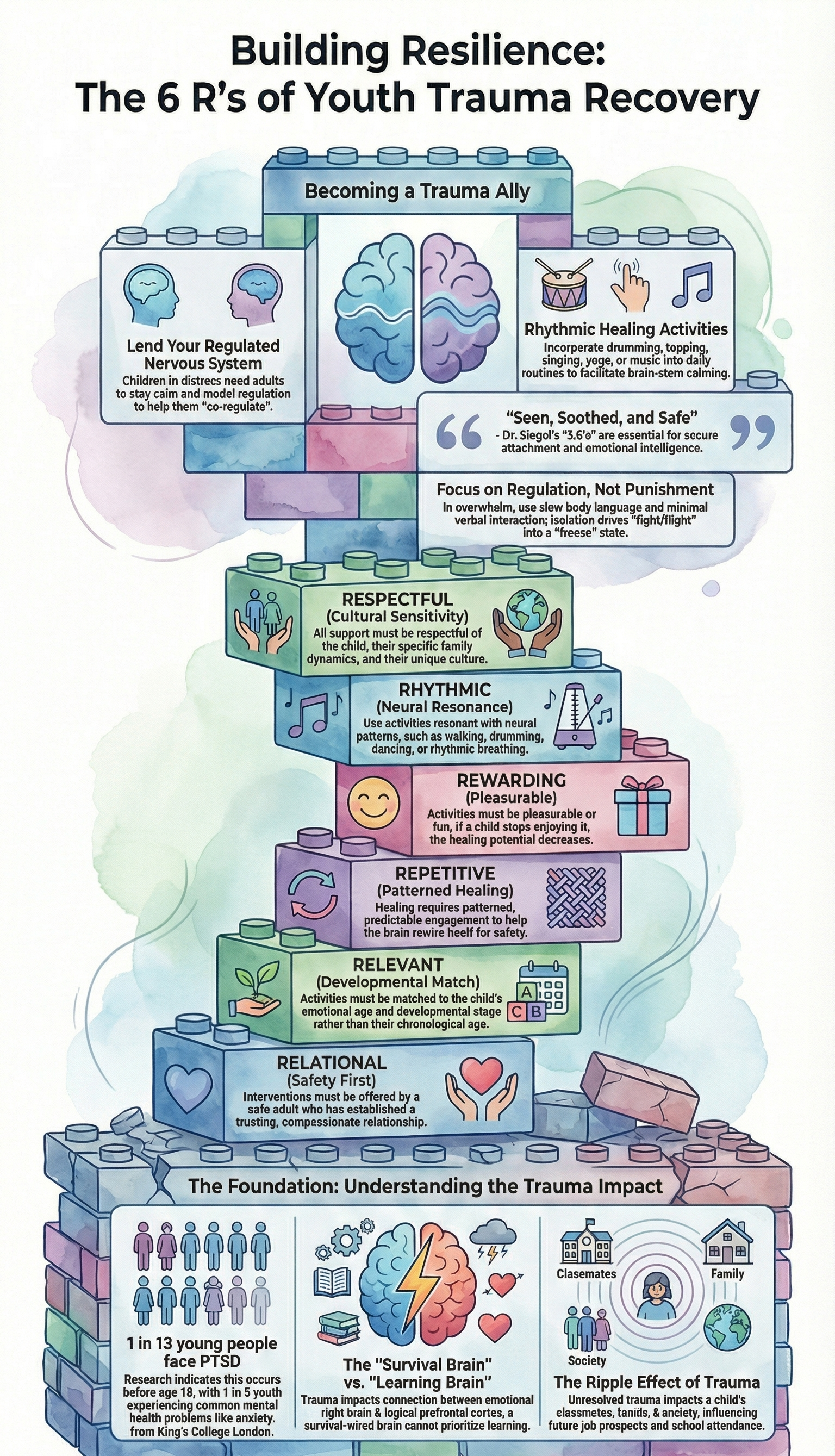
Supporting the Adults Who Support Children
There is another important part of this conversation.
Educators are not only teaching—they are holding emotional spaces, responding to distress, and building relationships in often demanding conditions.
The Teacher Wellbeing Index (2025) highlights significant levels of stress across the profession. Many staff are experiencing what is known as secondary traumatic stress—the emotional impact of supporting others through difficulty.
This is not a personal weakness.
It is a natural human response to caring deeply.
If schools are to be truly trauma-informed, staff support cannot be an afterthought. Reflective spaces, supervision, and a culture of care are not luxuries—they are what make relational work sustainable.
Because we cannot pour from an empty cup.
What Happens When We Get It Right?
There is strong and growing evidence that relational, trauma-informed approaches make a meaningful difference.
Targeted interventions such as nurture groups have shown:
Improved emotional wellbeing and regulation
Increased attendance
Greater engagement with learning
Schools like Outwood Academy Hemsworth have demonstrated that when leadership prioritises relational culture alongside clear structure, outcomes can shift significantly—including reductions in exclusions and improvements in attendance.
This is not about lowering expectations.
It is about creating the conditions where children can meet them.

A child feeling safe and confident enough to participate in learning—an example of how trauma-informed classrooms support regulation, engagement, and self-belief.
A Different Way Forward
At its heart, this is not about replacing behaviour systems or removing boundaries.
It is about deepening our understanding of what sits beneath behaviour, and designing systems that respond with both clarity and compassion.
Because when children feel:
safe enough
understood enough
connected enough
they are far more able to learn, engage, and thrive.
A Gentle Reflection for Schools and Leaders
If relationships are one of the strongest drivers of learning and wellbeing, how might we continue to shape our schools around them? Not as an add-on, but as a foundation.
If you're a school leader, educator, or professional reflecting on this, you’re not alone in navigating these challenges. Change doesn’t happen overnight—but small, relational shifts, consistently applied, can make a profound difference.
Working Together to Support Children and Those Around Them
If you’re reading this and recognising some of what’s showing up in your school or service, please know—you’re not getting it wrong. This is complex work, and many people are trying to support children with needs that don’t always fit neatly into existing systems.
At Youth Trauma Allies CIC, we come alongside schools, families, and professionals to gently support this journey towards more trauma-informed, relational ways of working.
There’s no expectation to have all the answers.
We offer:
Trauma-informed training and workshops for school staff
Support for developing relational, regulation-focused approaches across whole-school systems
Parent and caregiver workshops to strengthen understanding and connection at home
Collaborative partnerships with organisations who share a commitment to improving outcomes for children affected by trauma
Whether you are:
A school leader reflecting on how to better support your pupils and staff
A professional or service looking to build trauma-informed practice
Or an organisation wanting to collaborate to create wider community impact
If you’re a school wanting to support both pupils and staff, or a service looking to deepen your trauma-informed approach, or a parent wanting to find out how you can support your child move through distress, we’d really welcome a conversation.
No pressure, no hard sell—just a chance to connect and see what might be helpful.
Because when the adults feel supported, it becomes so much easier to support the children.
Together, we can begin to create environments where children don’t just manage—but feel safe enough to grow, learn, and belong.

📩 To connect or explore working together, please get in touch via direct message or email: liz@towardstranquility.com
